Building a Merchant Onboarding Platform with Next.js
Onboarding is the first thing a merchant sees of a payment gateway, and the last thing the risk team signs off on. At I Money Pay I build the platform that sits between those two moments. Here's how it's put together.
One application, many owners
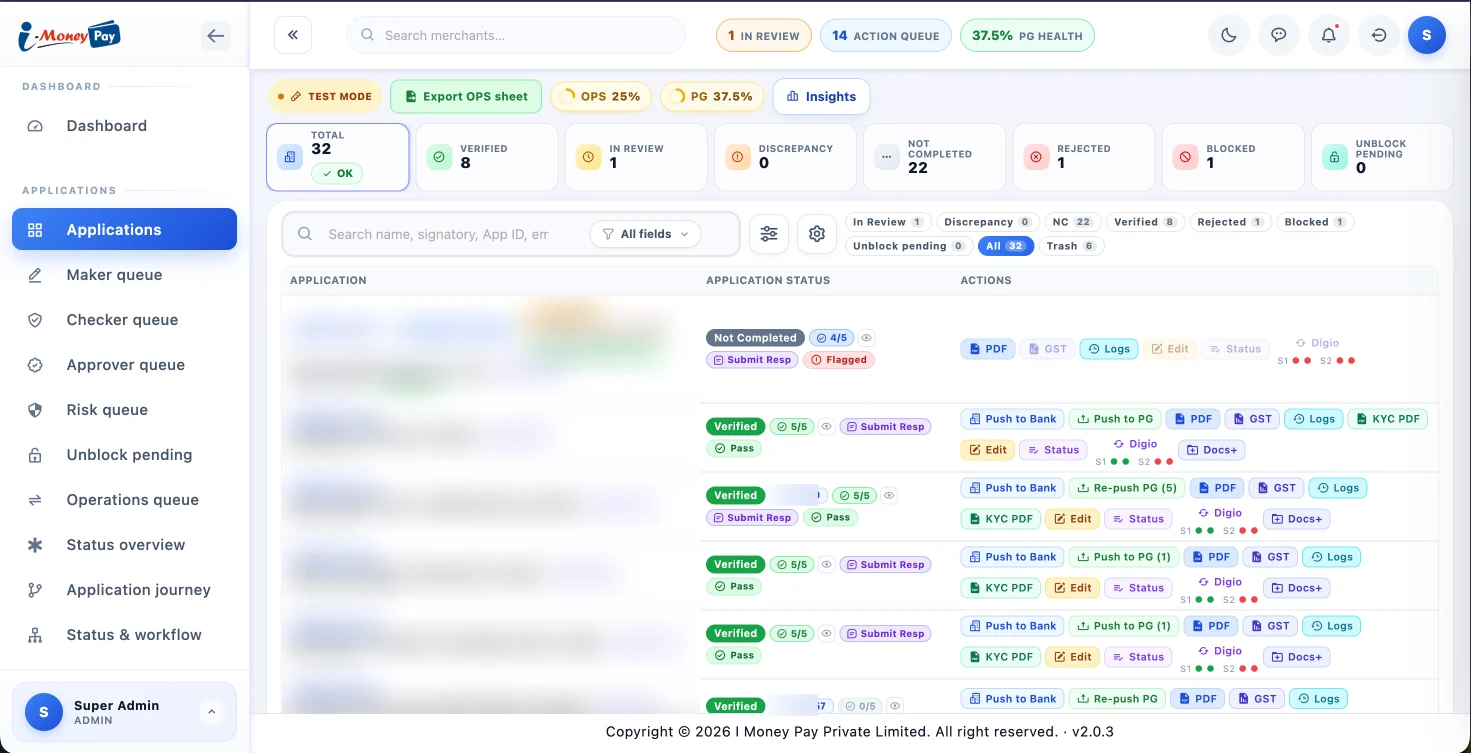
A merchant fills in business details, uploads KYC documents, adds a bank account and accepts the agreement. Internally that same application moves through Maker → Checker → Approver → Risk → Operations. The trick is to model the application once and let each department see only the actions it owns.
- A single status machine. Every transition (submit, raise discrepancy, approve, block) is a named event, so the UI and the audit log never disagree.
- Role-based access at the API. The front end hides buttons, but the server decides what a role is allowed to do.
- Autosave on every step. Long KYC forms lose people; saving drafts as they type keeps them.
Pushing approved merchants downstream
Once Operations approves, the merchant is pushed to the gateway to get a merchant ID and to the bank for account verification. Both calls are retried idempotently and their responses are stored next to the application, so support can answer "where is my account?" without opening a log viewer.
Keeping everyone in the loop
A daily digest email summarises every queue — new, pending, discrepancies, approved — alongside PG-health checks. It's a small feature, but it replaced a lot of "any update?" messages.
Design the workflow before the screens. The screens get much simpler once the states are honest.